The 41st Sale: When Amazon’s Free Plan Stops Being Free
| TL;DR Individual costs $0/month plus $0.99 per sale. Professional costs $39.99/month with no per-item fee.At 40 units the two are effectively level. At 41 the Individual plan costs $40.59, which is more.The crossover is not really about the fee. The Professional plan unlocks bulk listing, most report exports and advertising placement.A healthy target margin is above 30%, and the per-item fee eats that faster than sellers expect at low price points. Short version: the plan with no monthly fee is the cheaper option for about forty sales a month, and the more expensive option forever after. |
Two plans, one obvious-looking choice, and a decision most new sellers get wrong in the same direction.
The Individual plan has no monthly subscription and charges $0.99 for each item sold. The Professional plan charges $39.99 a month and nothing per item. Presented that way, with a new seller’s caution and an empty catalog, Individual wins every time.
It should. For the first month or two it is genuinely cheaper. The problem is that nothing in the interface tells you when that stops being true, and the answer arrives quietly.
Do the Arithmetic Once
Forty sales on the Individual plan costs $39.60. The Professional plan costs $39.99 for unlimited units. At forty, the two are within forty cents of each other.
Forty-one sales costs $40.59. That is more than the Professional plan charges for any number of units at all, and every sale after it widens the gap.
| Units sold in a month | Individual plan | Professional plan |
| 10 | $9.90 | $39.99 |
| 25 | $24.75 | $39.99 |
| 40 | $39.60 | $39.99 |
| 41 | $40.59 | $39.99 |
| 100 | $99.00 | $39.99 |
| 300 | $297.00 | $39.99 |
Read the last row. At three hundred units the Individual plan costs more than seven times the Professional plan, and it is still described in most beginner guides as the budget option.
The full comparison, including which features sit behind each plan, is worked through in this breakdown of the Amazon Individual vs. Professional seller account choice.
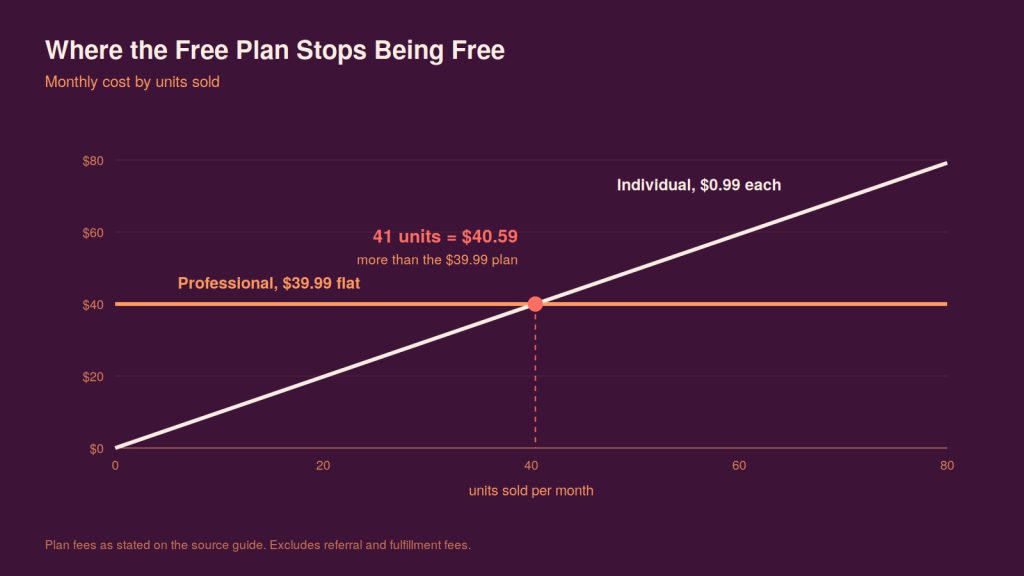
The crossing point is around forty units. After that the gap only widens.
Why the Fee Is the Least Important Part
If the difference were only forty cents at the crossover, this would be a trivial decision. It is not, because the plans are not the same product with different pricing.
The Professional plan is where bulk listing lives. It is where most report exports live. And it is where advertising placement lives, which matters more than the other two combined, because a listing that cannot be advertised is a listing waiting to be found.
That reframes the question. It is not “at what volume does the monthly fee pay for itself.” It is “at what point does being unable to advertise cost more than $39.99 a month.” For most sellers with any intention of growing, that point arrives well before forty units.
Sellers doing retail arbitrage hit the threshold fastest, because volume in that model can climb steeply and unpredictably. A seller who crosses forty units in a good week and does not notice is paying more for fewer features indefinitely.
The Fixed Versus Variable Distinction
There is a reason this trips people up, and it is not arithmetic. It is that a variable cost feels safer than a fixed one.
The Small Business Administration’s guidance on calculating your startup costs makes the point that you should count at least one year of monthly expenses, and that counting five is ideal. The reason that advice exists is precisely this bias: a per-unit charge disappears into the cost of each sale and never presents itself as a line item, while a monthly subscription arrives as a bill with your name on it.
The subscription feels expensive. The per-item fee does not. At forty-one units a month the per-item fee is the expensive one, and it will never send you a notification saying so.
Counting a year forward, as the SBA suggests, is what makes the comparison visible. Twelve months at a hundred units is $1,188 on Individual against $479.88 on Professional. Nobody makes that trade deliberately.
Where the Per-Item Fee Actually Hurts
The $0.99 is flat, which means its impact is entirely determined by your price point.
On a $50 product it is 2% of revenue and barely worth modeling. On a $6 product it is over 16%, and it lands on top of the referral fee, the fulfillment fee and your cost of goods. Sellers working in low-price categories on the Individual plan can find the fee consuming a meaningful share of a margin they were already defending.
Against a target margin above 30%, which is the healthy benchmark for a private-label product, a flat per-unit charge at low price points is not a rounding error. It is a structural problem with the plan choice.
What to Actually Do
Three checks, in order.
Look at last month’s unit count. If it exceeded forty, you are already on the wrong plan and have been for at least a month.
Look at your average selling price. Below about $10, the per-item fee is taking a share of margin large enough to matter regardless of volume.
Ask whether you intend to advertise. If the answer is yes at any point in the next quarter, the plan decision is already made, because the fee comparison is not the binding constraint.
Switching is not permanent in either direction, which is worth knowing because the reversibility removes most of the risk from the decision. The cost of switching a month too early is under forty dollars. The cost of switching six months too late is several hundred, plus whatever the advertising you could not run would have earned.